Asteroid 99942 Apophis
On April 13, 2029, an asteroid named Apophis will safely pass close to Earth and will come within about 20,000 miles of the Earth’s surface. This will be a close encounter, closer to Earth than the belt of geosynchronous satellites. Apophis’s closest approach is less than one-tenth of the distance of the Moon.

Apophis is oblong, estimated to have dimensions of 450 meters (1480 ft) by 170 meters (560 ft).
Apophis shape model (based on light curve data) is by Josef Ďurech and Vojtěch Sidorin
NASA overview of Apophis is at science.nasa.gov/solar-system/asteroids/apophis/
Close encounter with Apophis
A unique and rare spectacle will potentially be visible to about 90% of the world’s population on April 13, 2029. During a span of about 7 hours, billions of people throughout Australia, Asia, Africa, Europe, and eastern South America can view the motion of a nearby asteroid with their unaided eyes. Applying geographic analysis, we calculate that a total of about 7.6 billion people can potentially view this sight!
To be sure, there is absolutely no risk of a collision with Earth. This event will be a special opportunity to clearly see an asteroid perceptively move against the starry background. This event is also a science bonanza for astronomers who study asteroids in our solar system, yielding important information about their composition and how a planet’s tidal forces affect them. This science will be crucial should a future asteroid ever threaten Earth. Knowledge of the structure of small asteroids like Apophis will help guide the best strategy for deflecting an Earth-bound object of this kind.
To prepare the public for where this flyby will be visible, we’ve prepared a set of maps showing where on Earth Apophis can be seen. These maps were made in coordination with astronomers Dr. Richard Binzel (MIT), Dr. Richard Tresch Fienberg (American Astronomical Society/Sky and Telescope), and Ernest T. Wright (NASA Science Visualization Studio).
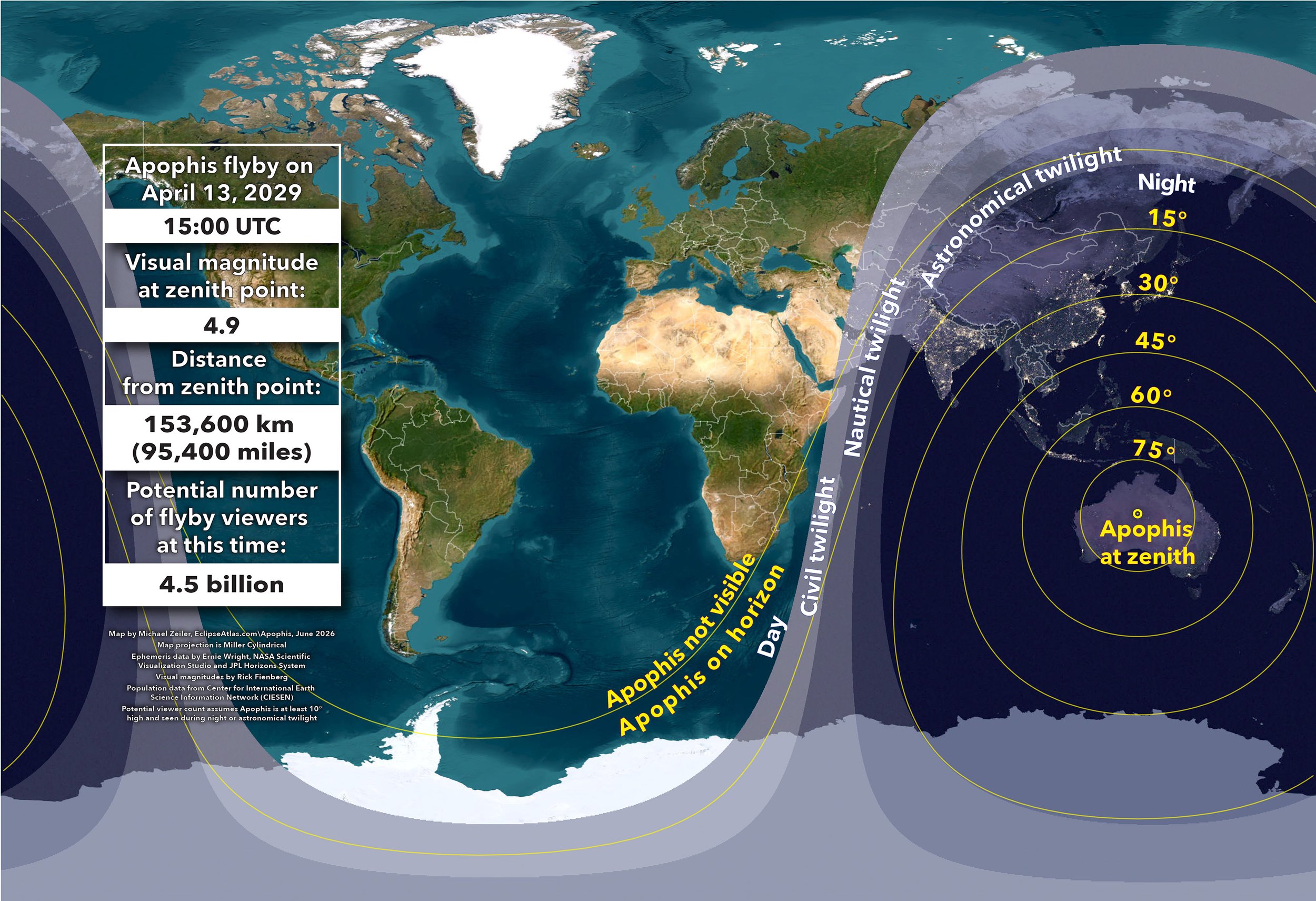
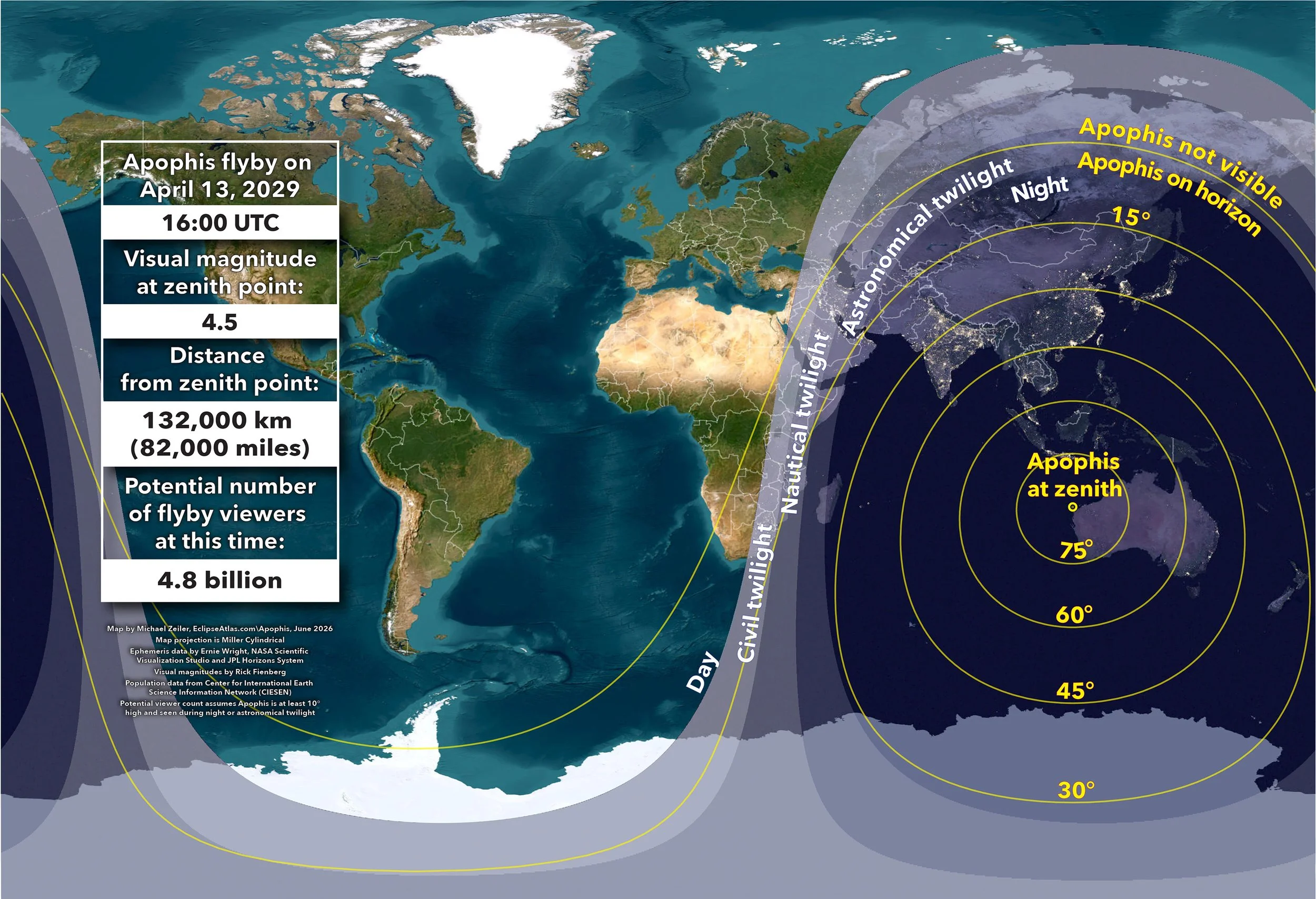
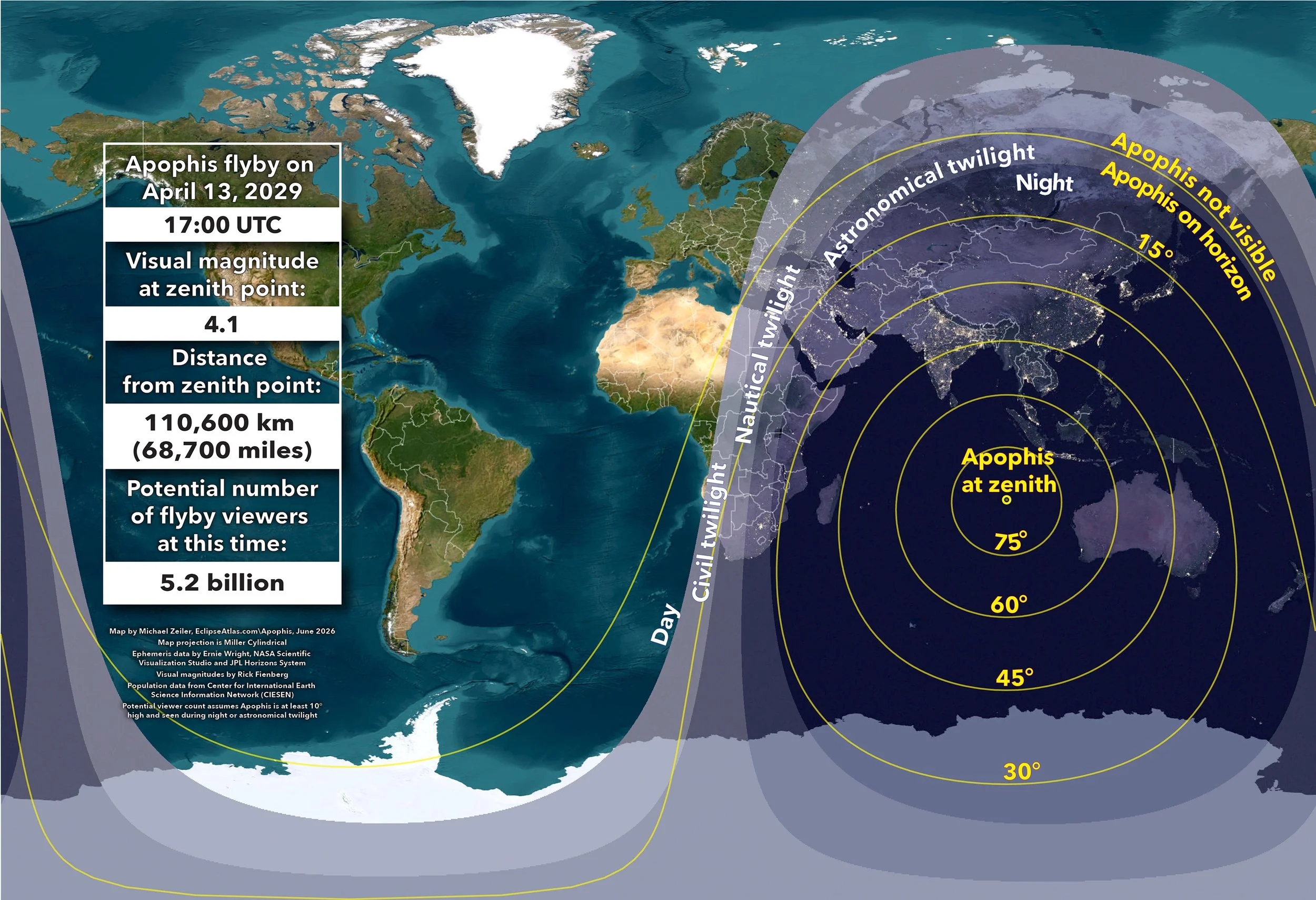
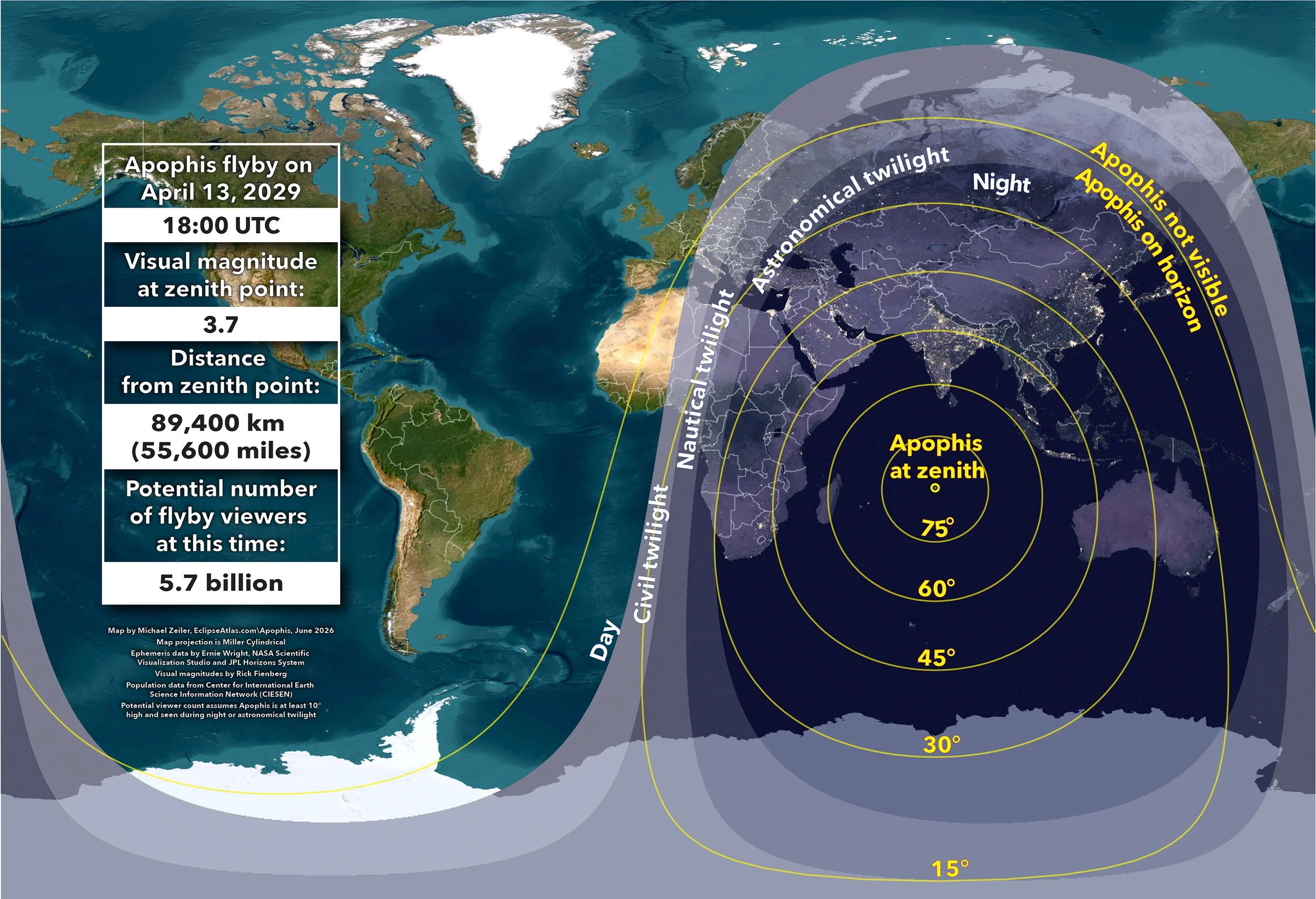
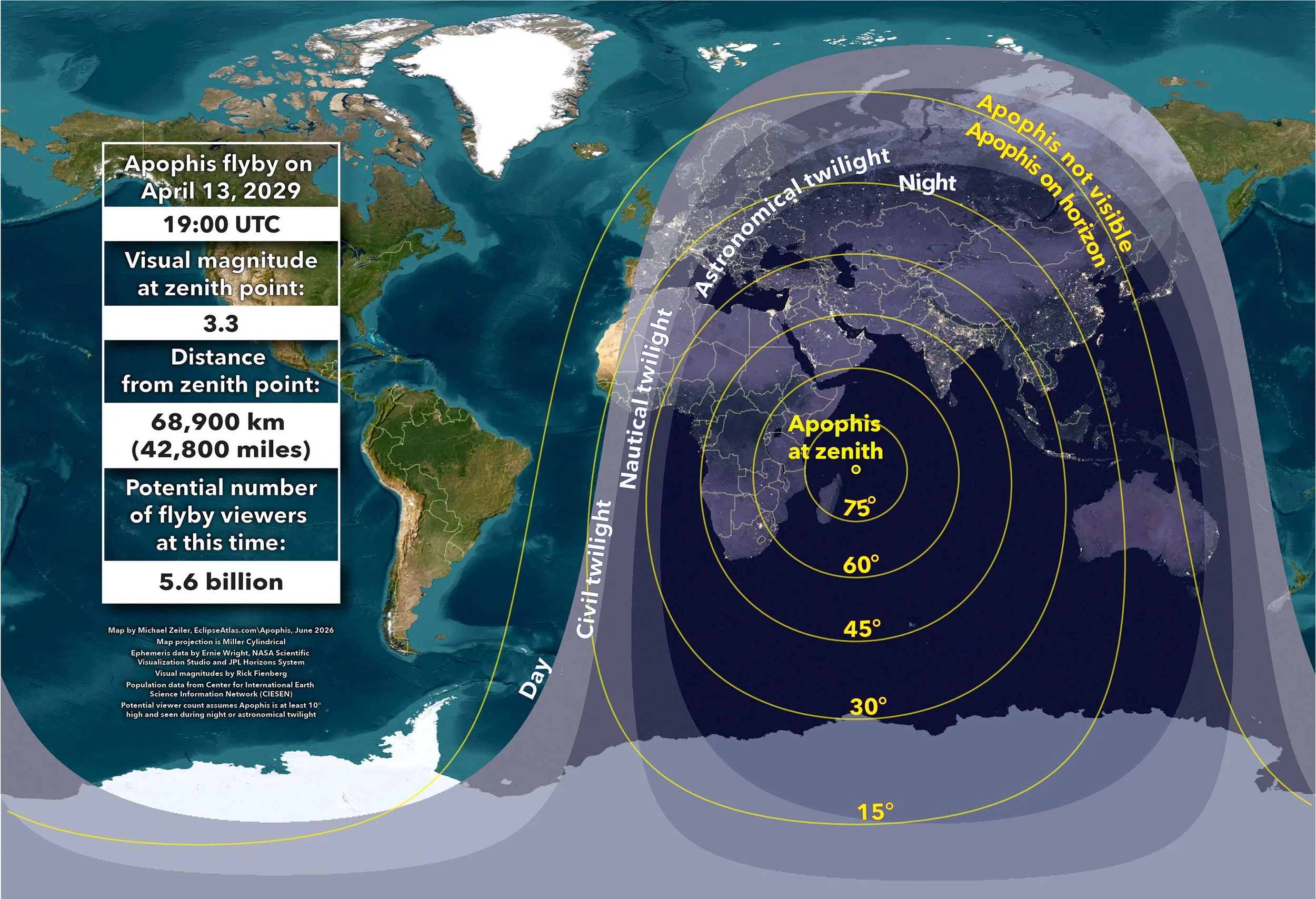
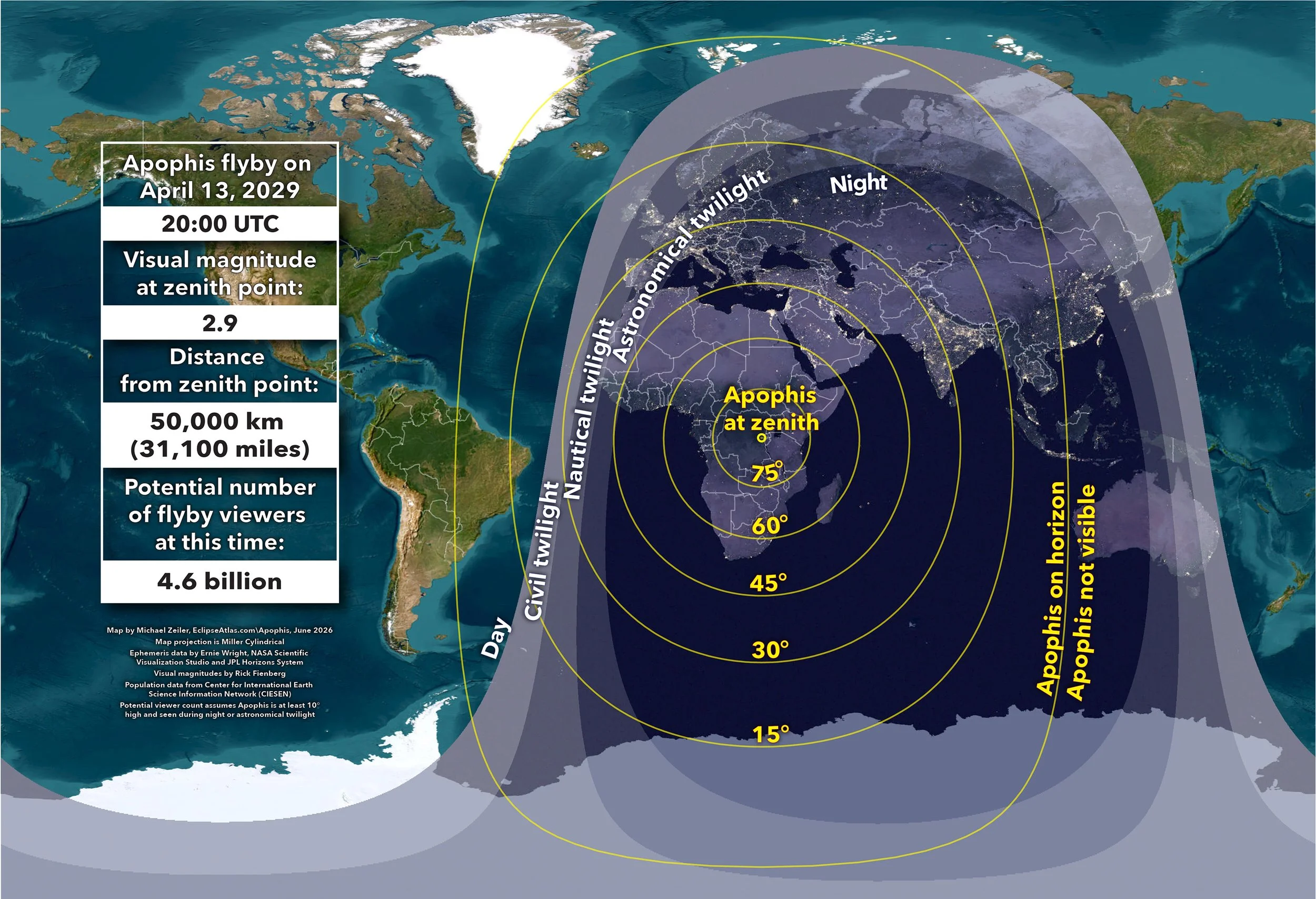
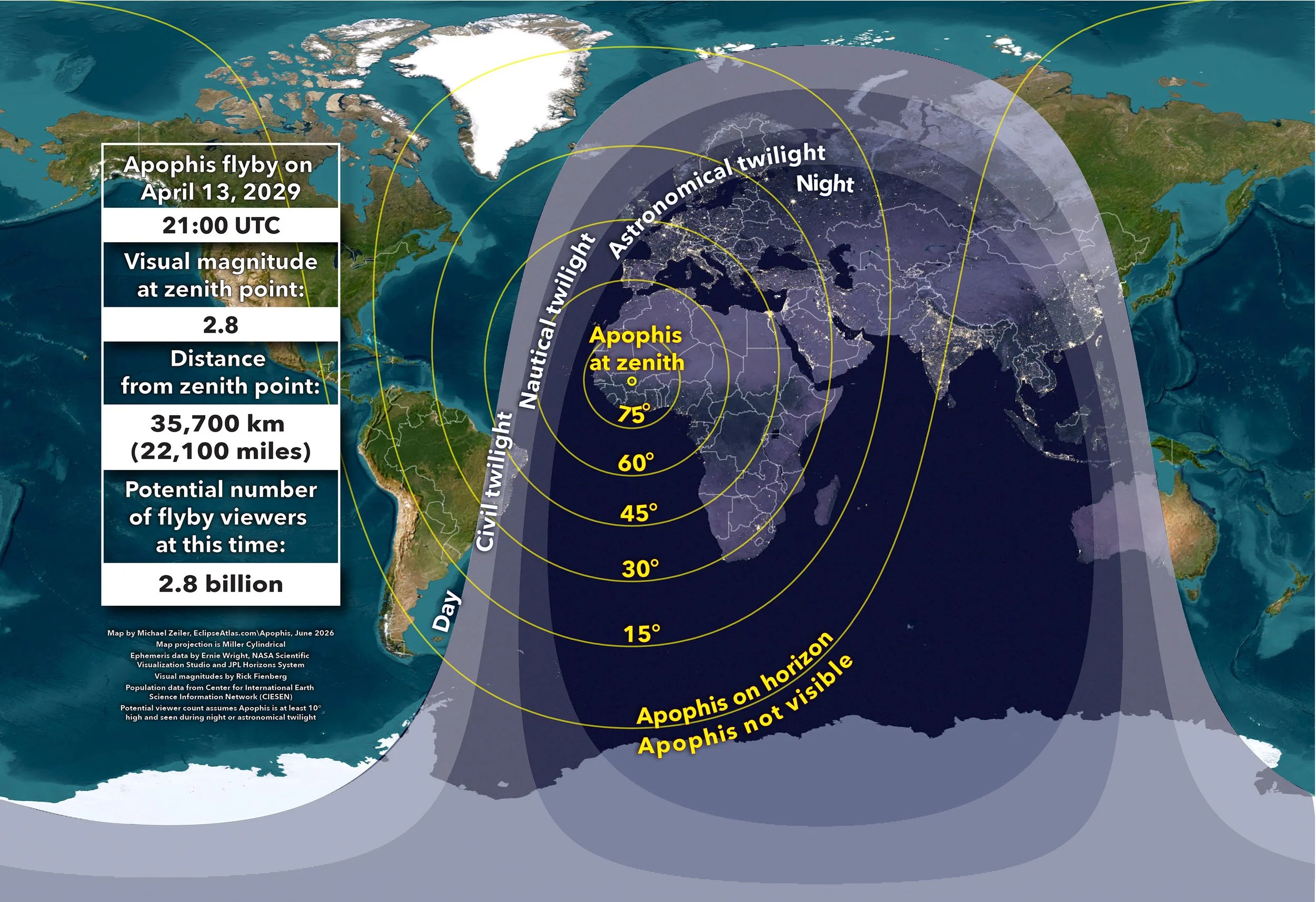
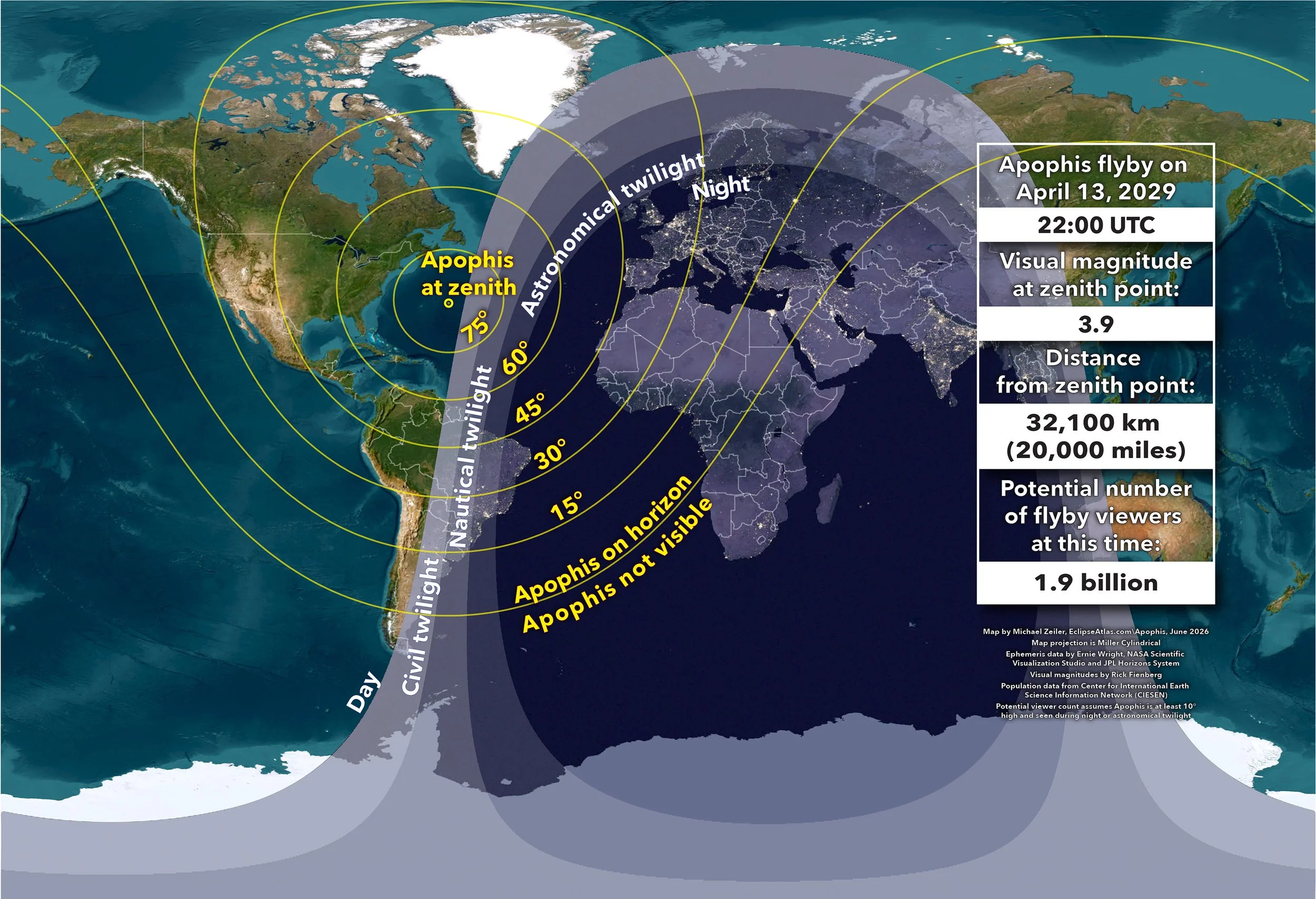
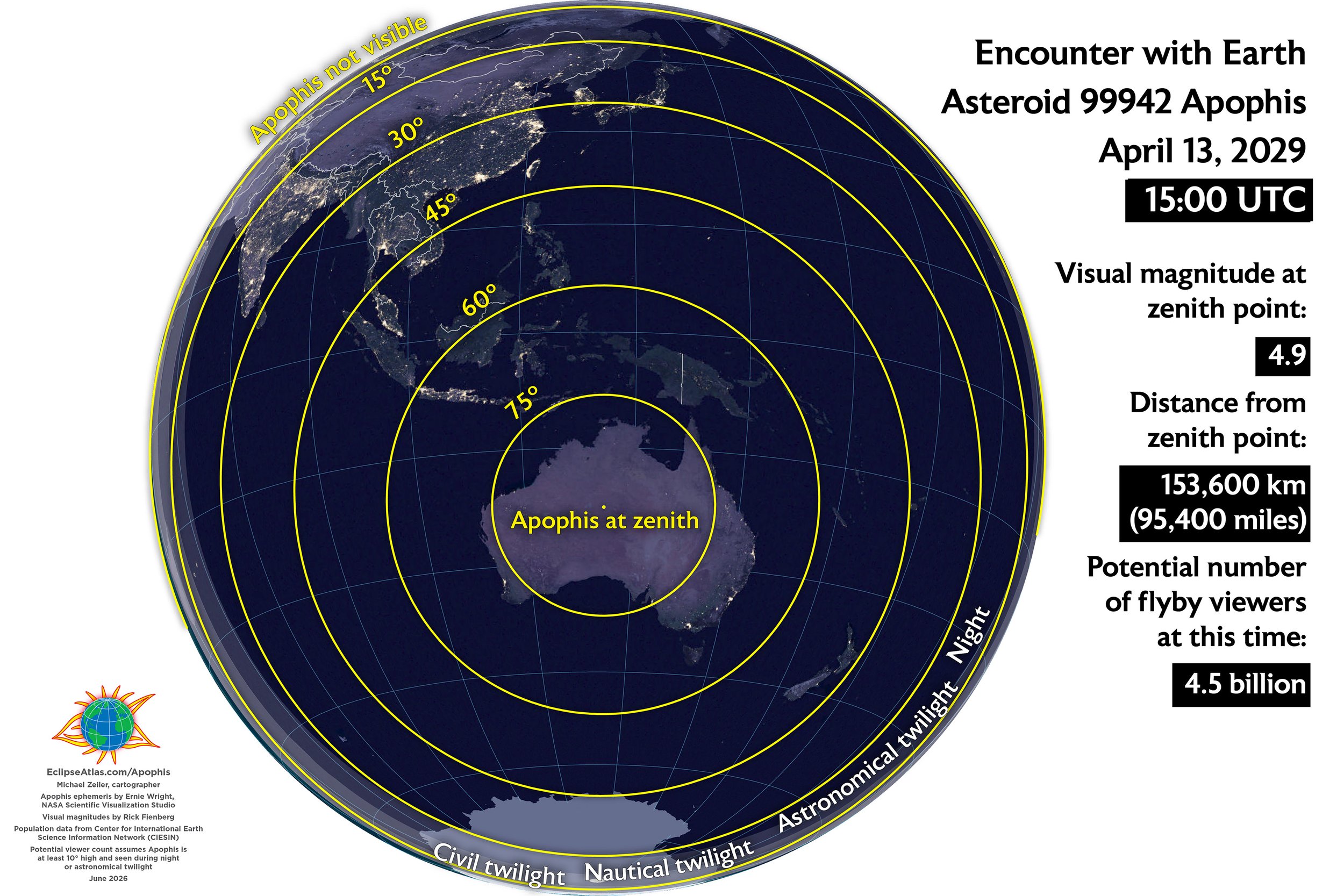
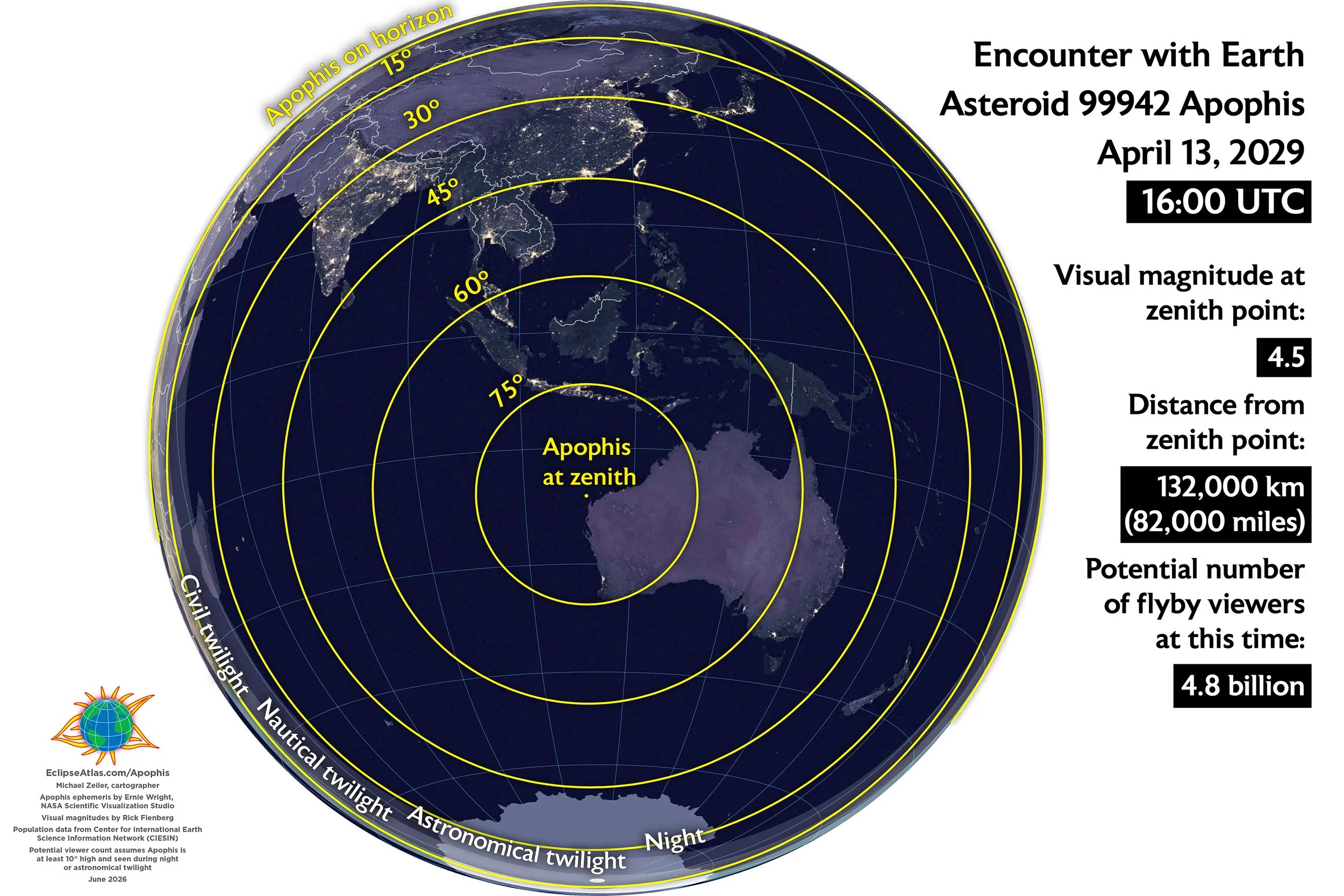
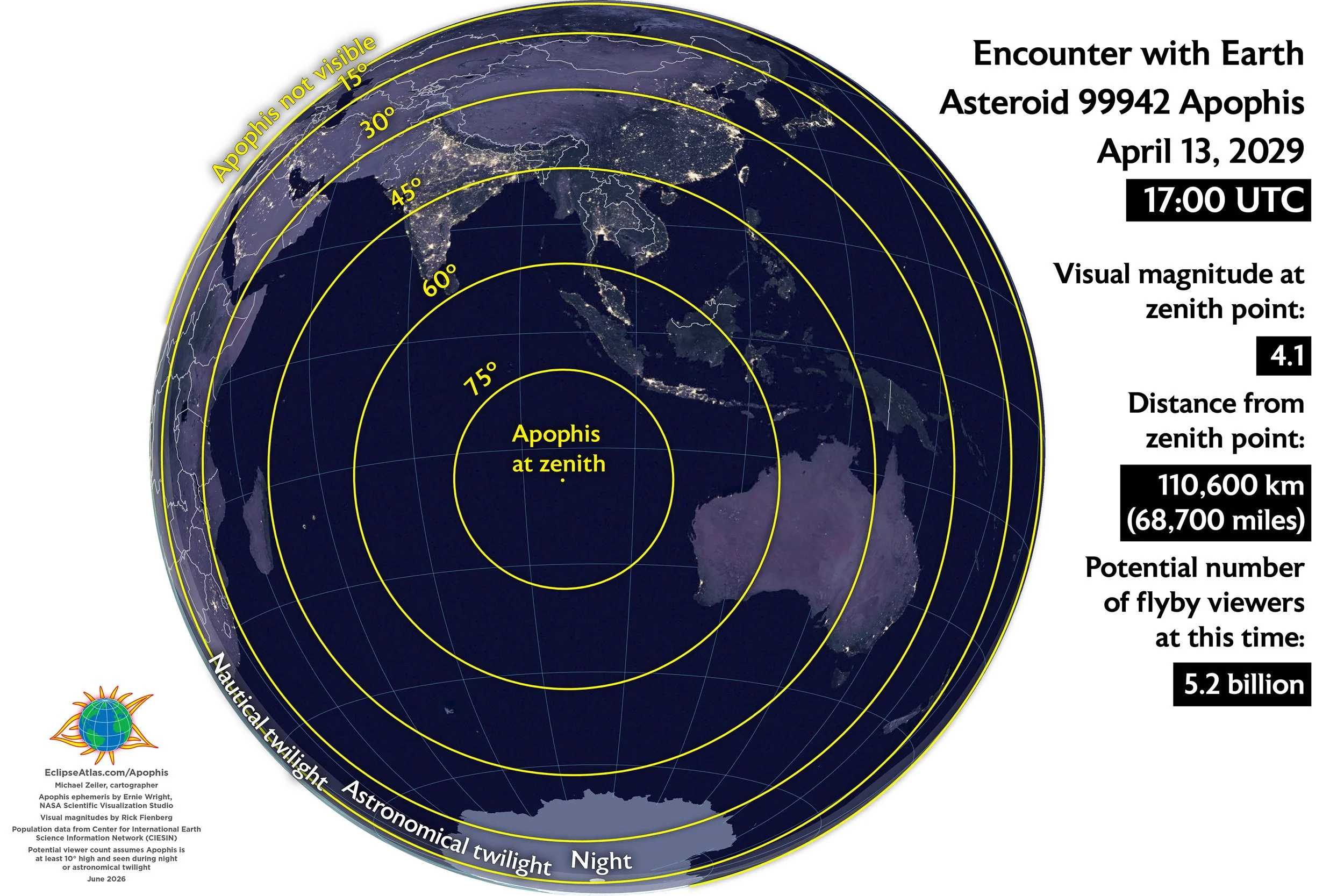
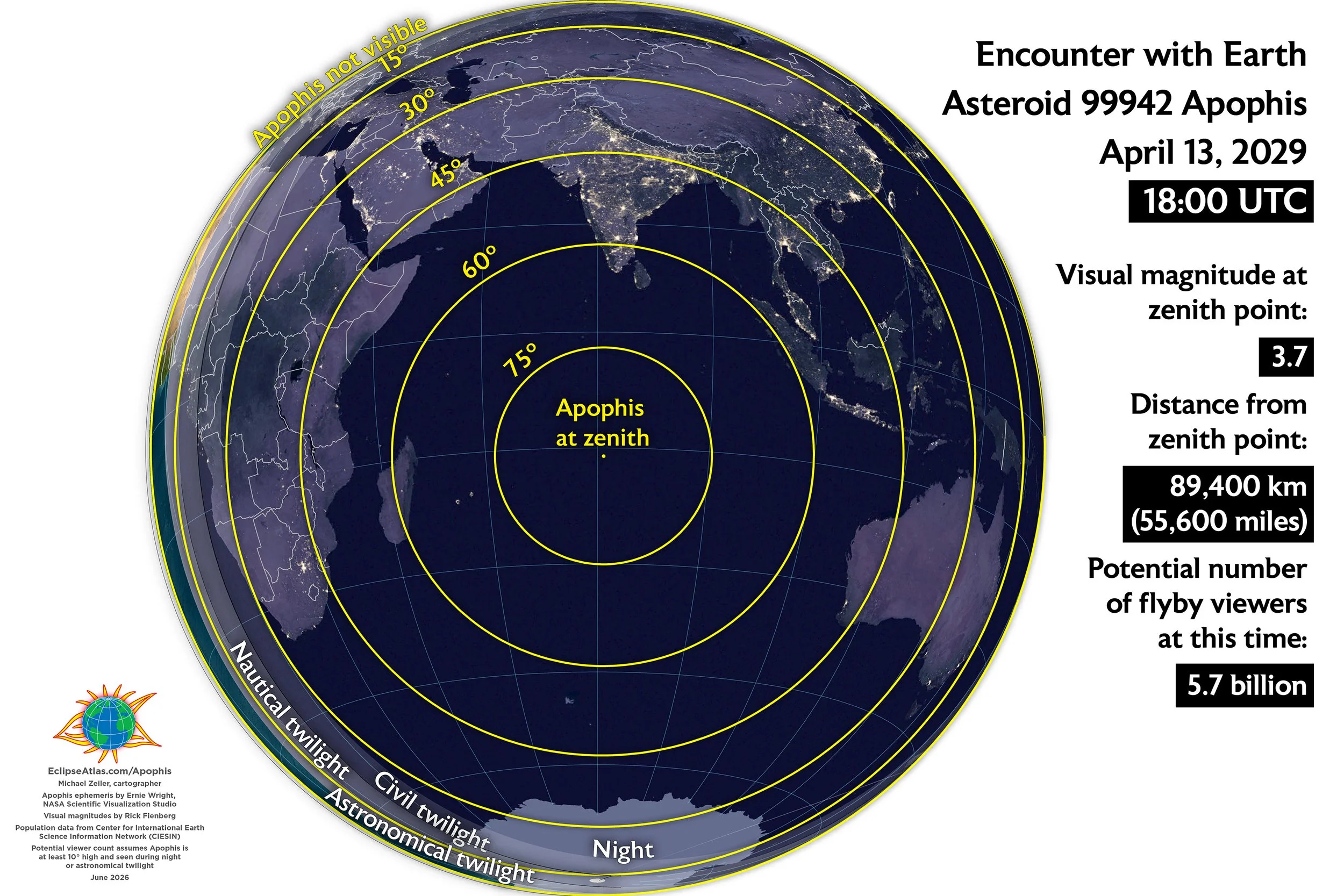
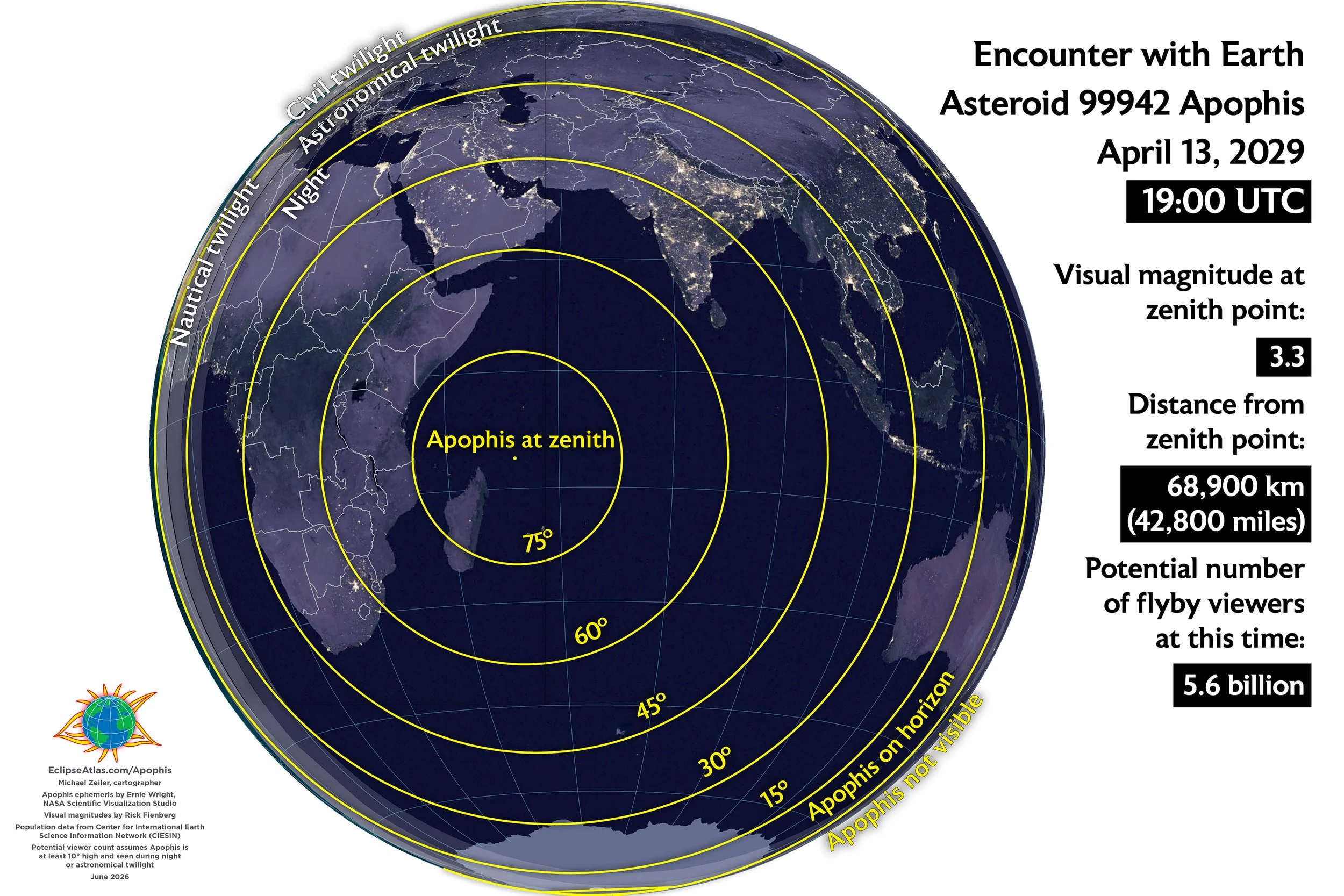
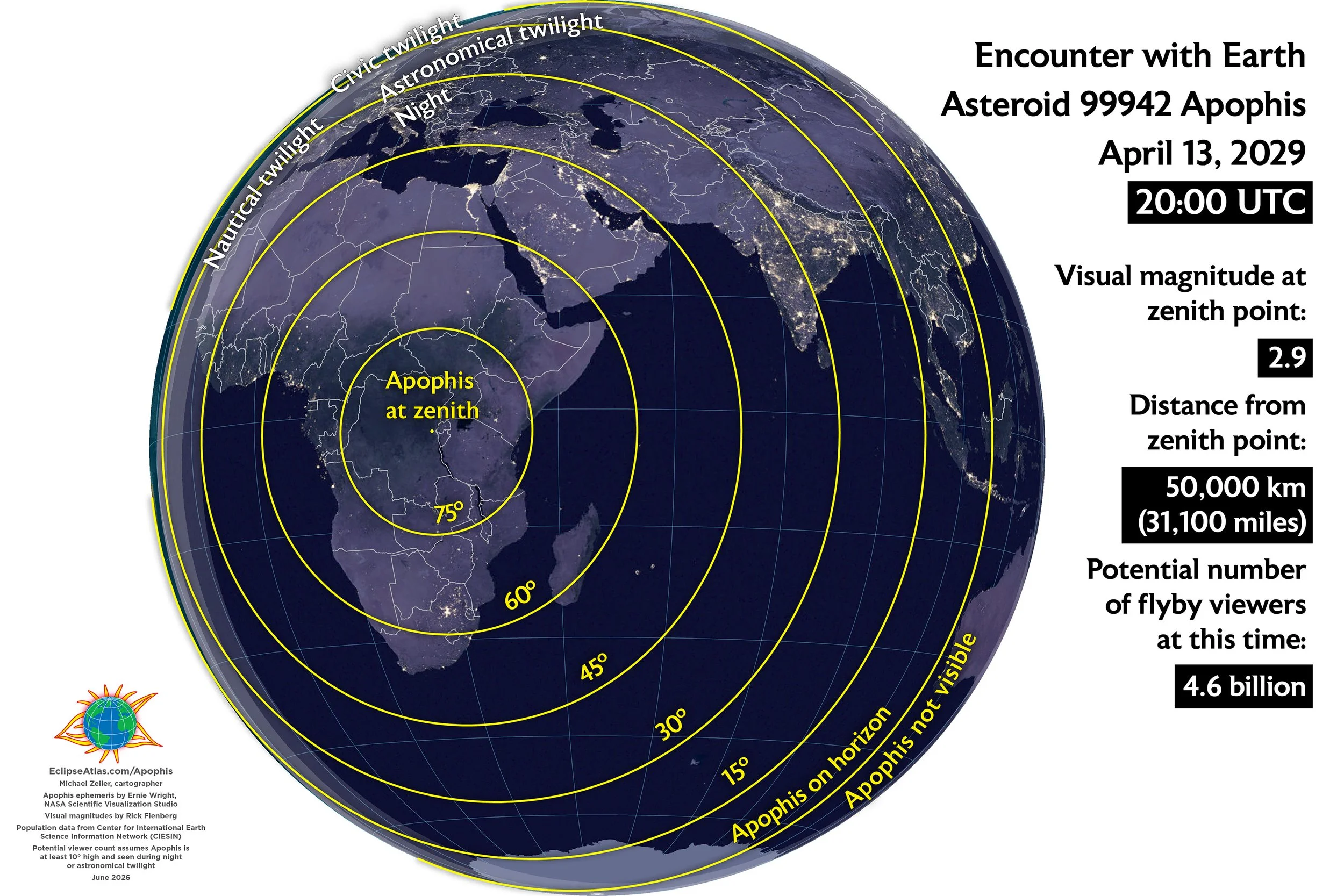
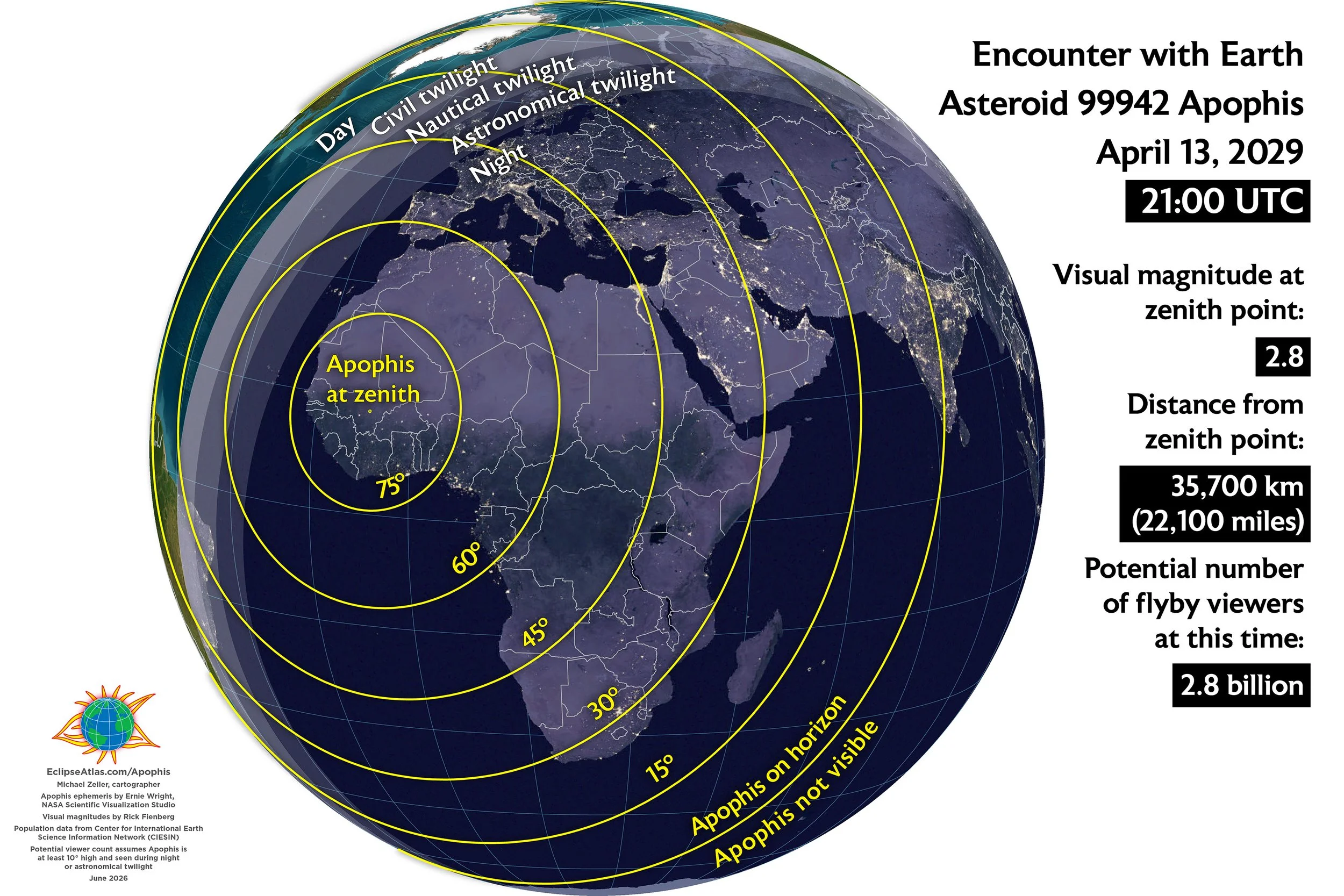
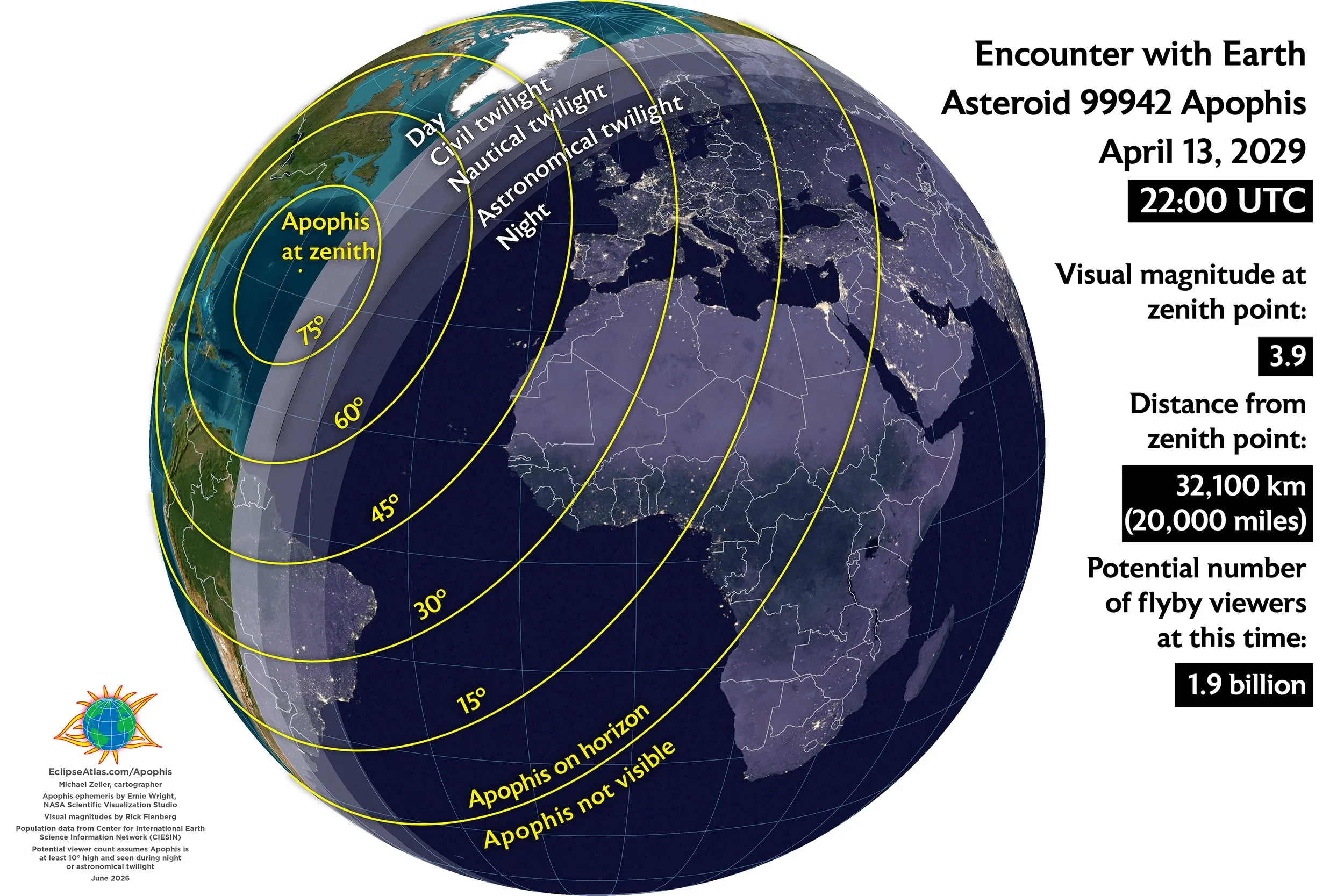
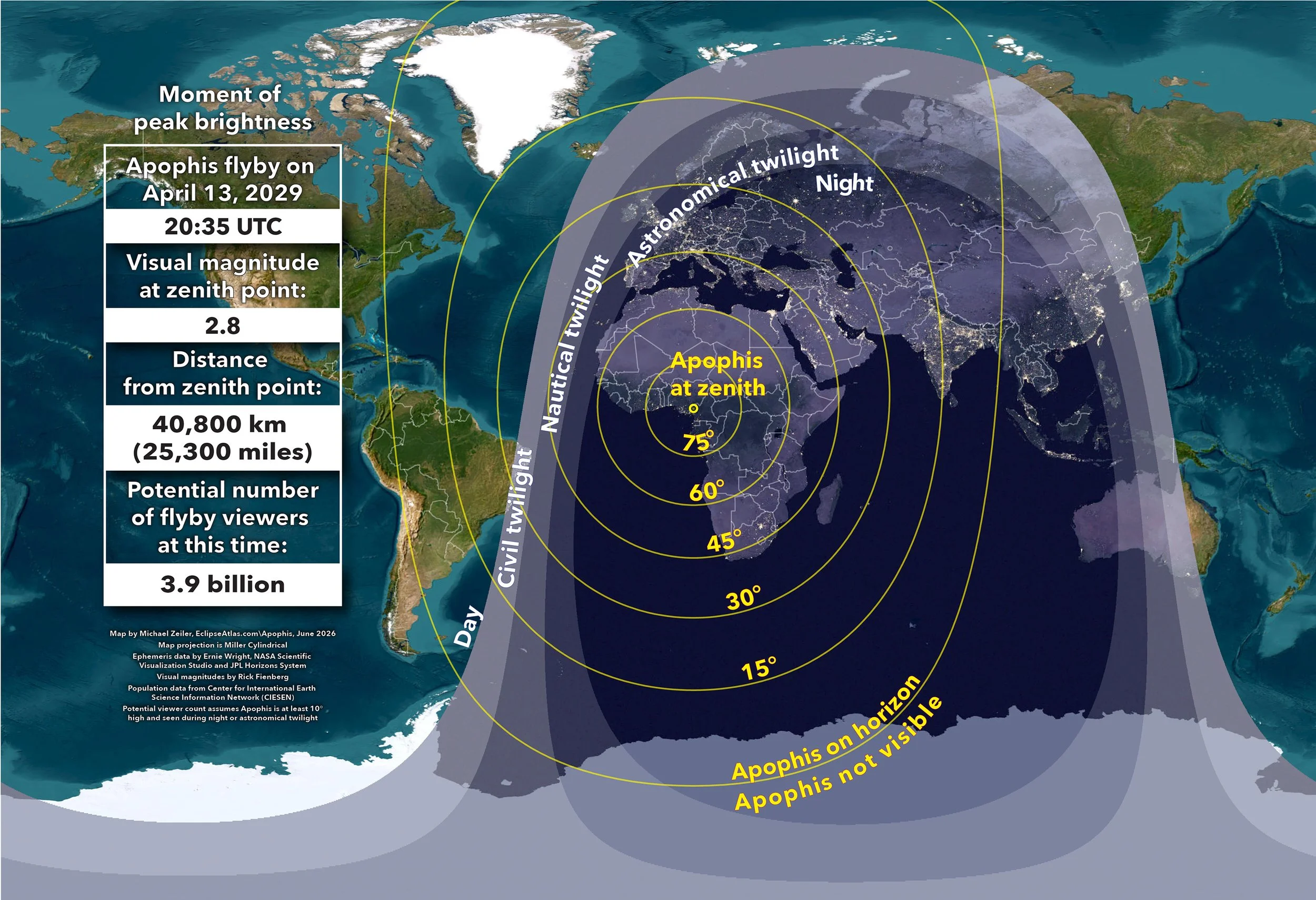
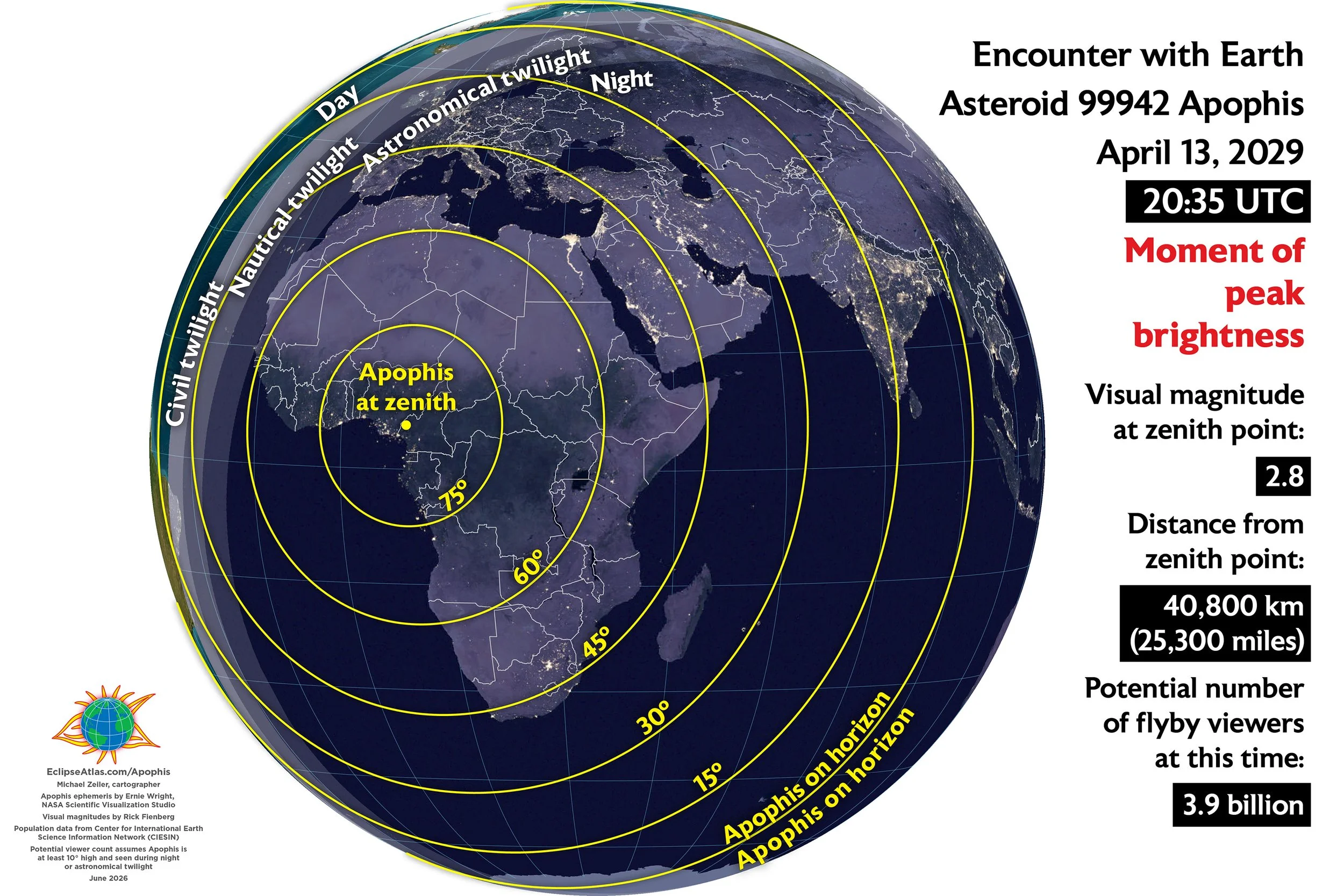
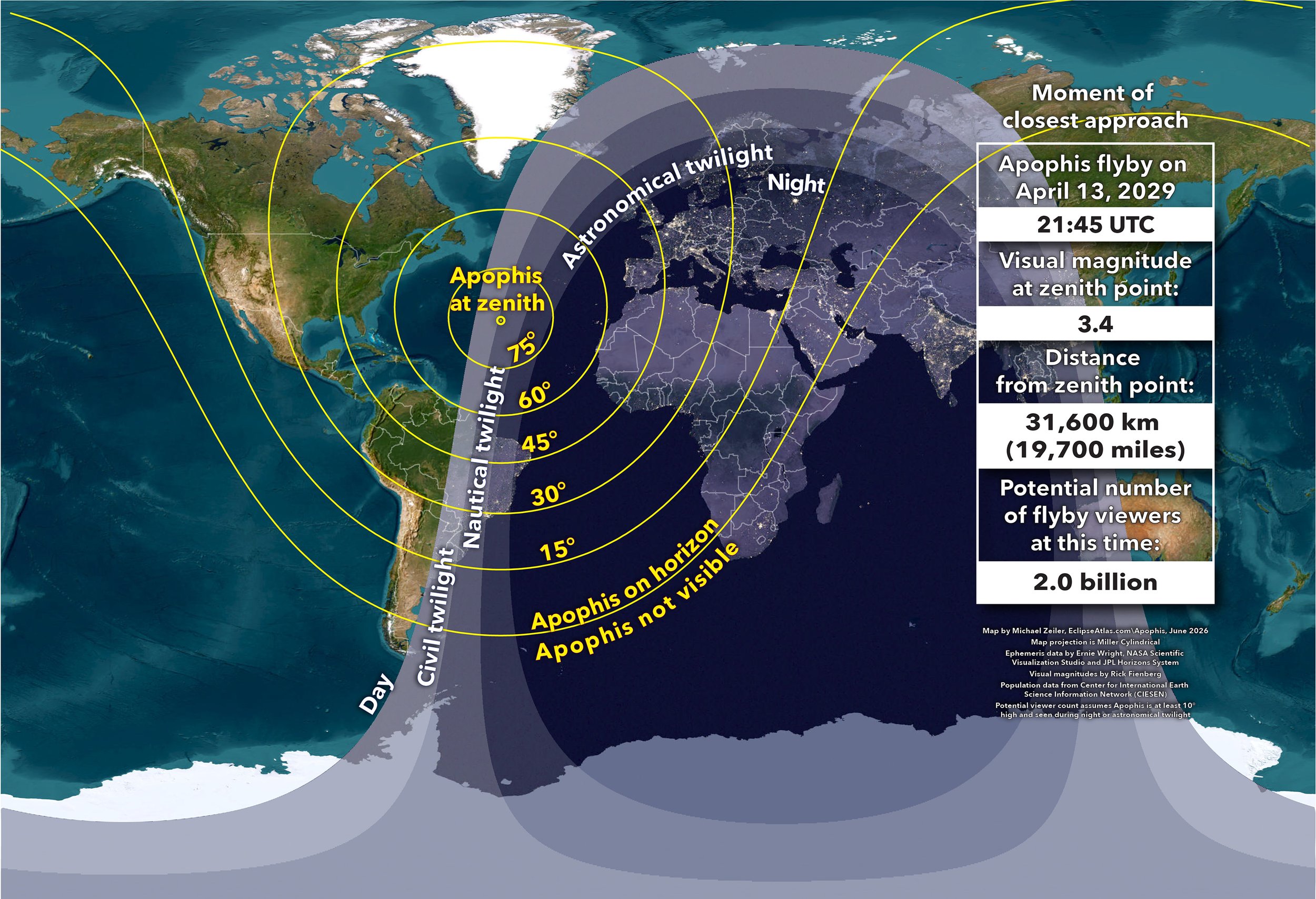
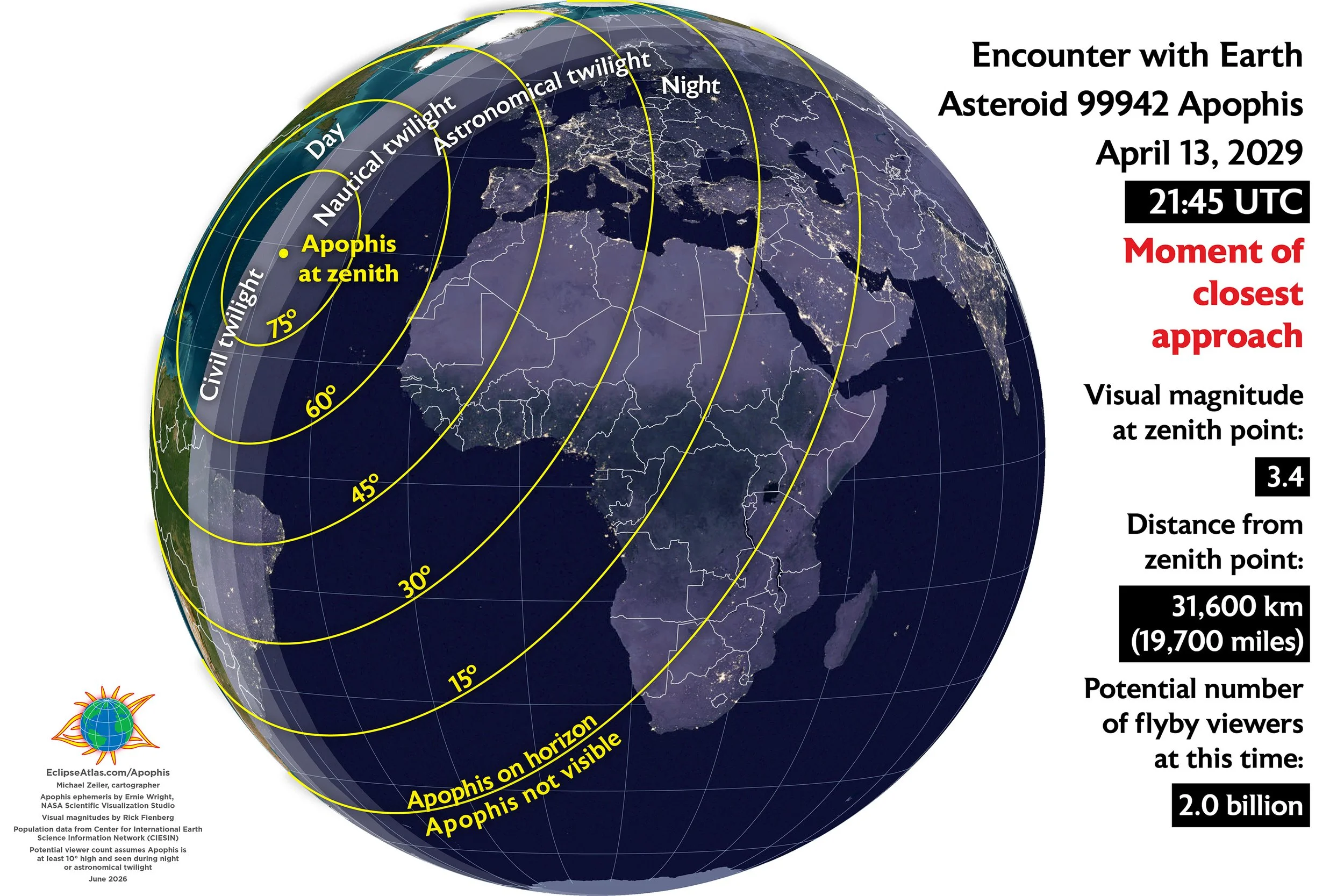
The maps below will tell you where Apophis can be seen at nighttime or deep twilight, how high in the sky, at what brightness, the distance to Apophis, and how many people can see Apophis for each hour from 15:00 UTC to 22:00 UTC. The maps give both hemispheric and world perspectives of the visibility of Apophis.
Diagram by Roger Sinnott, Sky & Telescope. Click to enlarge diagram.
The dotted ellipses show the regions of sky within which the asteroid will appear, depending on your location on Earth. Observers in southern latitudes will find Apophis in the upper half to the ellipse and observers more northerly will see Apophis in the bottom half of the ellipse. This time span from April 12 0:00 UTC to April 13 12:00 UTC precedes the closest approach of the asteroid. During this time span, Apophis will be visible throughout the world through binoculars or small telescopes.
Diagram by Roger Sinnott, Sky & Telescope. Click to enlarge diagram.
The plotted curves on the star map show where Apophis will appear from Namibia, Cameroon, Canary Islands, Sicily, and Ukraine. The tick marks show where Apophis will be seen at 19:00 UTC, 20:00 UTC, 21:00 UTC, and 22:00 UTC from these locations. Note that the rate of motion is highest between 21:00 UTC and 22:00 UTC.
Peak brightness and closest approach
Two of the key events of the encounter between Earth and Apophis are the moment of peak brightness (as seen from Earth) at 20:35 UTC and the moment of closest approach at 21:45 UTC at a height lower than geosynchronous satellites. Click on any map to enlarge.
Hourly maps of Apophis visibility on Earth
You can use these maps to plan an observation campaign that optimizes the visible duration of the encounter, a good night sky during Apophis’ peak brightness and closest approach, and viewing Apophis at a high sky altitude. These hourly maps are made for approximately the time span when Apophis can be potentially seen with the unaided eye. Click on any map to enlarge.